I hope we can all look forward with some grace for our nation, our communities, and those we love.
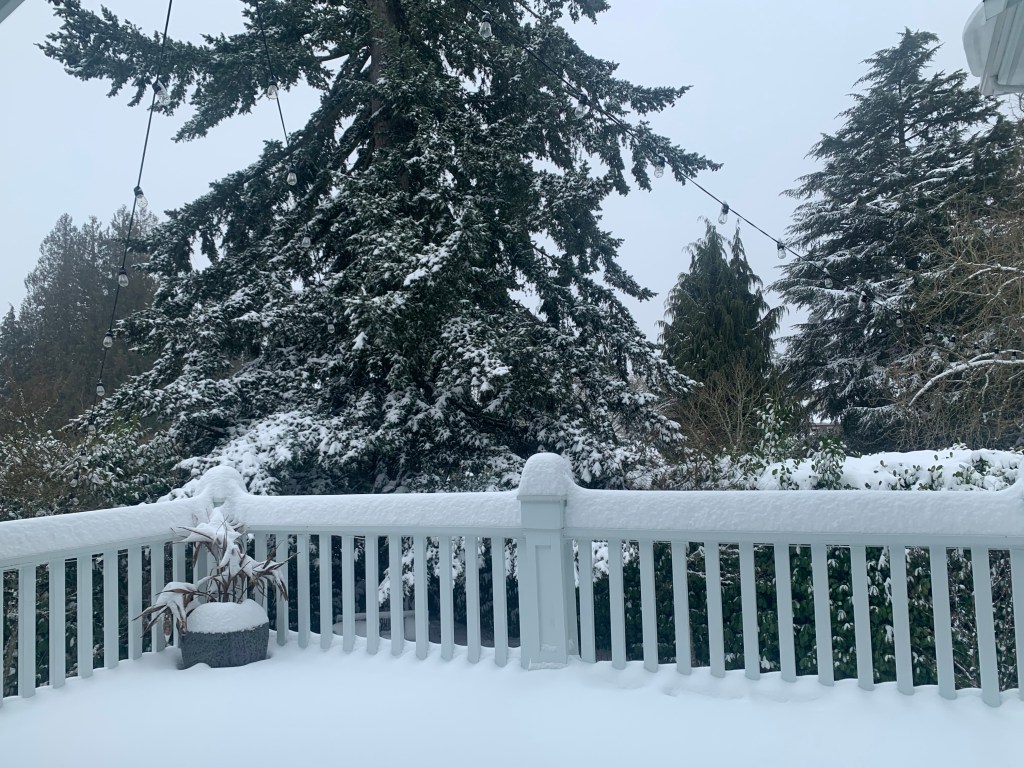
It is a snow day in Seattle. These don’t happen very often. So when they do, the world feels magical.
I woke up happy and refreshed. Grateful for a good/hard week, where I wrapped up a work project that had largely consumed my last month/s. I’m learning that being part of a lean – yet highly ambitious start-up – means you wear a lot of hats. In the last month, this has meant writing an entire website and editing an entire series of videos (check it out at Truveta.com!). I love the work, really, but it hasn’t left much room for my side creativity.
I also have felt stuck. Stuck in a pandemic. Stuck in a world that is making some progress (yay for vaccines!). But not fast enough.
This week brought some big developments. For the first time since the pandemic began 11 months ago, my son returned to physical school (with 25% of his classmates in a carefully architected ramp-up plan). He got to actually go to an actual basketball practice. Inside a gym. As a year-round player, the loss of his favorite sport has been hard. Teenage kids should be able to pursue their passions with freedom.
Importantly, I received my second dose of the Moderna vaccine – a critical step forward on the path to normalcy. My husband also received the vaccine, as did my oldest daughter, who is 18. I share this with trepidation. We are not the conventional recipients people expect to have been vaccinated. Yet, for our family, it is crucial to protect our youngest member – who is 13 and unable to get vaccinated (as none of the vaccines have been approved for those under 16).
This is a forgotten scenario in the distribution plan. Families with kids with significant special needs and health conditions with compromised immune systems (in our case, epilepsy, which causes seizures – at times uncontrollable absent hospitalization – during serious bouts of the flu). These kids not only can’t be vaccinated, many also can’t reliably and safely wear masks, wash their own hands, or do other basic self-protection methods. The best way to protect them right now is to protect those around them.
So, with high integrity, we classified ourselves as home health care aides (in fact, full time caregivers, along with our nanny). If any of us get COVID-19, there is no one available and trained to care for our youngest. If she gets COVID-19 and ends up hospitalized, we want to be healthy so we can go with her to the hospital. As a non-verbal child, she needs parents with her. And if we get COVID-19, we would put her at significant health risk.
I am so grateful for science. I am so grateful for vaccines. I am so grateful to be able to glimpse a path toward normal life.
And, I am so grateful my parents have also gotten their first dose of the vaccine (with their second dose on the horizon). I have not seen them in over a year – the longest absence, by far, in my entire life. During this year, my dad was diagnosed and is being treated for cancer. A heartbreaking chapter to be absent from. Because of our vaccinations, we will reunite in about a month when the inoculation has kicked in – and I simply cannot wait.
All of these developments have made it hard for me to know what to write. The reason? Judgment.
One of the saddest impacts of COVID-19 on our communities has been the overwhelming judgment it has brought. From every direction. Early on, our last President politicized a pandemic, which created an environment of judgment that persists today.
Are we doing enough to protect ourselves and our communities? Should we have the “freedom” to live however we want, with those at high-risk left to fend for themselves? Are we wearing masks appropriately? Are we traveling or gathering selfishly? How do we protect our kids from a pandemic while also supporting their mental health? What is the right balance for each family, knowing circumstances vary widely?
In our country, the guidance has varied widely from state to state. My current home state of Washington has been conservative, with sweeping shut-downs across schools, businesses, restaurants and essentially our entire society for the last 11 months. In my original home state of Missouri, it is a different world. Kids are going to school. Playing sports. People are frequently traveling to out-of-state sports activities. Families are congregating. Celebrating holidays together. Until recently at least, when the virus was getting out of control. If you pay attention to the data, you can see the dramatic difference in impact based on efforts to contain the virus. But clearly, many, many Americans aren’t paying attention to the data – or have decided living life as normal is worth the risk.
These discrepancies – and related fatigue with how very long this pandemic has lasted – have created harsh judgment. Within our nation. Within communities. Within extended families. Within nuclear families. This judgment adds to a sense of isolation and loneliness.
For me, it also has made it hard to write. Some of the most important developments in my life (I GET TO SEE MY PARENTS SOON!!) are clouded in fear of judgment.
But this morning, I have a different outlook. Life is awfully short to worry about judgment.
I hope we can all look forward with some grace for our nation, our communities, and those we love. None of us know the full details of particular circumstances. And we are all desperate for a return to normal.
At the same time, I hope we take smart precautions to help protect our communities and those we love. The risk is still high. And even with light on the horizon, we need to be diligent to save as many lives as we collectively can.




 The Redefining