
I’m thinking a lot about time lately. Largely, how there never seems to be enough of it.
It’s tied to this blog, in that I need to find time to write it. And the creative energy to write something worthwhile.
I’m trying not to worry about a specific cadence. Or quality bar. Or editorial calendar. Although it is SO in my nature to want to map it out specifically. For now, I’m going with the “no plan” approach in the spirit of unplanned fulfillment.
But it is a fact of reality for most of us that time is seriously compressed. Requiring daily, if not hourly, prioritization to spend time on what matters most.
This week-end, apparently, this blog didn’t matter most. Instead, a fun dinner with friends, shopping for the perfect gifts for my soon-to-be 15 year-old daughter, watching TV with my big kids, organizing for an upcoming house move and other week-end household chores, going for a few runs, watching my son’s cross-country meet, taking my daughter for a manicure, finishing my book club book, and hosting a dinner party for extended family took priority. No wonder I didn’t find time to write.
I do love that while my time felt compressed, it was intentional. As much as I love to write, I didn’t love it enough to choose it over the other items.
The importance of the intentionality of time resonates with me. Two recent studies caught my eye and reinforced this:
First, I ran across a very cool TED talk from Adam Alter. He analyzed a pile of data from the Bureau of Labor Statistics and the app Moment, which tracks smartphone use, to assess how people spend time. He found that sleep and work take up roughly two-thirds of your day, pretty much any year. Same for survival activities, such as bathing and eating. Our time spent on these activities has largely stayed unchanged.
What has changed? How we spend our precious remaining free time – really just a few hours a day for most of us. The big difference? Screen time.
Compared to 2007, when screens ate up mere minutes of our free time, the ratio has now flipped. Practically all free time now goes toward screens. Check out this chart – I found it eye opening.
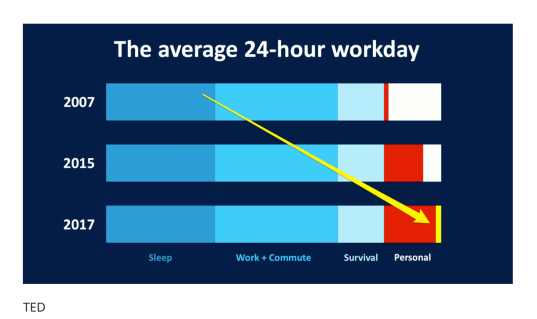
The red space represents all the time we spend on screens. The puny yellow and white slivers that remain? Which is decreasing significantly each year? This is where the “where the magic happens,” Alter says. “That’s where your humanity lives, and right now it’s in a very small box.”
It’s interesting that the spike in time spent on screens maps to the growing adoption of smartphones and social media. The correlation is not by accident. The iPhone was introduced in 2007. It is so easy to get lost in your phone – scanning various social feeds, reading news, playing games and tap, tap, tapping. How much of our life are we – potentially – wasting by tapping on our phone versus living our life?
The types of experiences on screens vary of course. In Atler’s speech, he describes two types of activity:
1) relaxation, exercise, weather, reading, education and health
2) dating, social networking, gaming, entertainment, news, and web browsing
In category #1, we spend about 9 minutes each day on each activity. In category #2, we spend about 27 minutes each day on each activity. The big difference?
Category #1 has been proven to drive happiness – and category #2 has been proven to drive unhappiness when used to excess. In the case of social networking, in particular, there are many studies that show the more frequent you use social media, the more likely you are to suffer depression.
In one study, participants that use social media very frequently have 2.7 times the likelihood of depression due to exposure to “highly idealized representations of peers on social media elicits feelings of envy and the distorted belief that others lead happier, more successful lives,” says the study.
In summary, “People that engage in activities of little meaning on social media makes them feel like they are wasting time.”
I don’t think this is unique to social media. I think it’s true for any activity that you spend a ton of time on that does not have meaning.
Here’s another interesting cut from the Bureau of Labor Statistics. It breaks down the buckets even further.
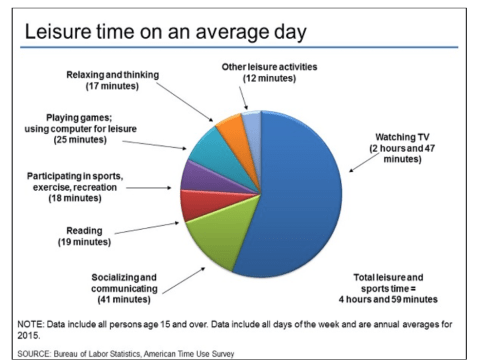
No judgement – for real – but amazing to see the difference between time spent relaxing, reading and exercising vs. watching TV and socializing/communicating (i.e. social media). If we get, on average, 4 hours and 59 minutes of leisure time each day, shouldn’t we make it the absolute BEST 4 hours and 59 minutes possible?
Since I’ve started paying more attention to the concept of time, here are a few changes I’ve noticed in my life. Much less aimless TV (although re-runs of Friends are always good and I can get sucked into HGTV very quickly (how do you NOT watch a whole House Hunters to see which house they choose?), neither really feels like time well spent – for entertainment or otherwise). Much less time on social media. Much less carrying my phone around like an extra appendage.
Instead, I’m being much more mindful of making time to exercise. Reading great books. Learning new things. Finding a few TV shows that are amazing to really enjoy. And having real conversations with people I love.
That’s not to say I’ve given up aimless activity – we all need down time. But ensuring we make the MOST of our down time is a good goal. Because time is precious. Every hour of the day.
As Atler says, “Life becomes more colorful, richer, and more interesting” when we step away from screens. We have “better conversations and really connect with people.” It’s the difference between looking at the ocean from a moving car – or – putting your toes in the sand, feeling the ocean breeze and sun on your face, and hearing the waves.
And wouldn’t we all choose to put our feet in the sand, feel the breeze on our face and hear the waves?

 The Redefining