
Tonight I’m speed-reading a book I chose for tomorrow’s book club. Reese Witherspoon actually chose it first for her book club and I saw several other authors I like discussing it. The book is called “Fair Play” by Eve Rodsky. The subtitle of the book is “A Game-Changing Solution for When you Have Too Much to Do (and More Life to Live)”.
Ok! I want more life to live!
Eve’s premise is that each human on earth deserves to live their best, most authentic life. Each of us should have the time to develop the skills and passions that keep us interested and interesting. Right??
Particularly once we become parents, but in any co-habiting relationship, we risk becoming out of balance. And we lose who we are, or who we can become.
Sound familiar? Uh….yes.
The premise of the book is a system that offers couples a new way to divvy up domestic responsibilities. Truthfully, I can’t see the system working in my house and I didn’t love parts of the book.
But I did love the parts of it that made me think about the hidden costs of mom-ing and ideas for balancing. Or at least, it reinforces that yes! holy cow I do a lot around here!
At the beginning of the book she articulates why women in particular struggle with being so busy. I say this cautiously – because many men, including my husband, contribute a lot to make a household run.
But there were a few key areas sociologists claim women disproportionately have to manage.
The first is Mental Load. The “never-ending mental to-do list you keep for all your family tasks.” It creates stress, fatigue and often forgetfulness. This is why I can’t turn my brain off at night and lose my car in parking garages.
The second is the Second Shift – the domestic work you do long before you go to work and often even longer after you get home. This is why I could never lay on the couch and take a nap while the house is a mess or there is laundry to do. I often wish I could, but…impossible.
Then there is Emotional Labor. It’s the “managing relationships” part of the job. It’s being the consoler of tears, the giver of advice, the one who notices when kids have had a bad day. It’s deeply feeling the stress of health or emotional or social concerns. It is exhausting. Deeply meaningful at times, yes, but emotionally hard.
And last but not least, there is Invisible Labor. It’s the behind-the-scenes stuff that keeps a home and family running smoothly. Hardly noticed and rarely valued. This is the we have snacks to eat, dental appointments scheduled, carpools sorted, and holiday gifts purchased line item. Yep.
There is more, of course, but these items resonated with me as I made yet another to-do list this morning. I was able to work from home today, which I love, and in lieu of my commute, I tried to get on top of our life. This is a never-ending job and today, looked something like this. I didn’t nail it. I made some progress, but this list is evil, because it never gets done. Here was my Mental Load for today:
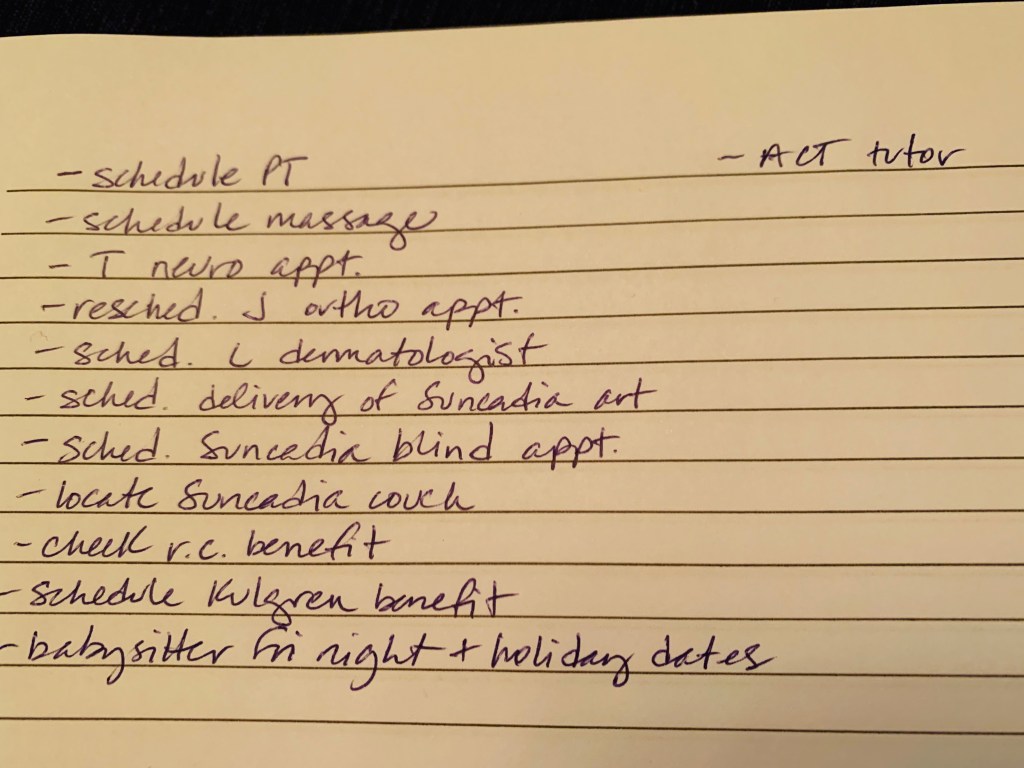
If not careful, this washing machine of activity can make it easy to lose ourselves in the chaos. This isn’t to say I don’t love being a mom – I love my kids so much – but it is interesting to recognize similarities that sociologists, scientists and psychologists have empirically proven.
Consider this:
- The pay gap between mothers and non-mothers is wider than the pay gap between men and women. What?? We never hear about this. Essentially, those of us who work took an economic risk by becoming parents.
- There is a legit “mommy tax” that decreases a mother’s earning power by 5-10% for every child she brings into the world due to missed opportunities, prestigious assignments, pay increases and bonuses.
- 43% of highly qualified women with children take a career detour – often unexpected. Not necessarily because they have always wanted to be a fully present parent, but sometimes because they are drowning in the demands and difficulty of combining work and parenting.
- Women are twice as likely to be affected by anxiety disorders as men because we are so desperate to do it all.
As Amy Westervelt is quoted in the book, ” We expect women to work like they don’t have children and raise children as if they don’t work.”
Ring a bell? I know it does for my female colleagues at work. Particularly those in dual-income families or single parents.
And, for my friends that work fully in the home, I know this will likely resonate too. The pressure they carry is significant for often unsung, underappreciated and never-ending work.
That isn’t to say that most of us would change anything. Even with this dynamic, no one I know wants to give up their kids and our families are our top priority. But understanding the realness of the impact of the mental load, second shift, emotional labor, and invisible labor is valuable – for women and men. Not only for how we can improve our lives today, but how do we evolve a society, a culture, and a workforce to reduce the pressure? And how can our girls expect more for their future? I want my daughter to know that she can have a career. And be a great mom. And not have to do it all perfectly. But still be near-perfectly happy.
I like a book that makes me think. I like a book club book that will drive good discussion. Fair Play delivers, even if the proposed solution may not work for me.

 The Redefining